
ESD storage container

- ESD protection
- Solder and solder agents
- Factory equipment
- Personal protective equipment (PPE)
- PCB processing and handling
- Component processing
- Component storage
- SALE
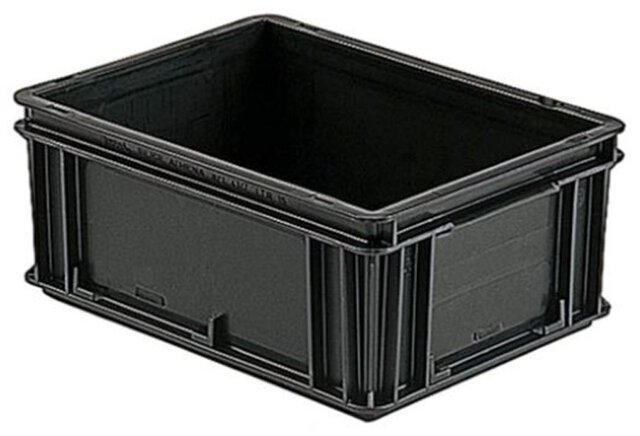
ESD container, polypropylene, dissipative, 400 x 300 x 75 mm

Protective case with conductive coating (outside only), unequipped
Protective case with conductive coating (only on the outside) and insert for SafeGuard measuring devices, unequipped
Why are ESD storage containers used?
ESD storage containers protect sensitive electronic components from electrostatic charge during storage and in-house transport in the electronics industry. At the same time, they support structured material flows in production, storage and order picking.
What are the differences between conductive and dissipative containers?
Conductive containers dissipate electrical voltages very quickly, while dissipative materials reduce charges in a more controlled manner. Dissipative storage solutions are often used for sensitive electronic components.
Which components are stored in ESD storage containers?
Typical applications include printed circuit boards, SMD reels, electronic assemblies, connectors and sensitive semiconductor components. The containers protect against mechanical stress and electrostatic discharge.
Why are stackable ESD containers useful in production?
Stackable container systems improve warehouse organisation, material access and space utilisation within production and storage areas. At the same time, they facilitate the transport and picking of electronic components.