
Personal protective equipment (PPE)

- ESD protection
- Solder and solder agents
- Factory equipment
- Personal protective equipment (PPE)
- PCB processing and handling
- Component processing
- Component storage
- SALE
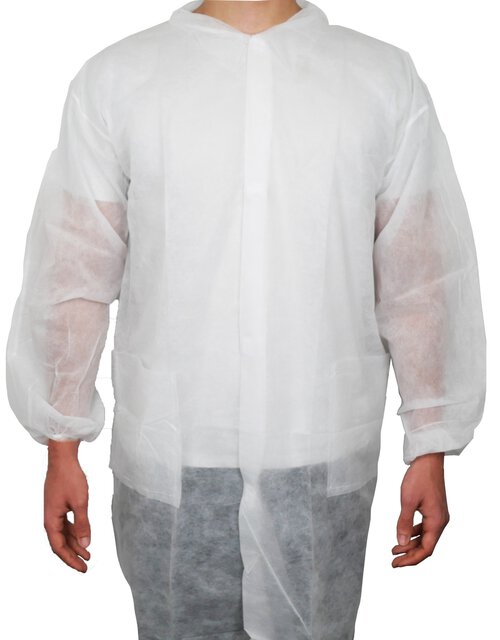
ESD disposable gown with snap fastener, breathable, 28g/m², unisex,


ESD beret hood with elastic band, Ø 60 cm, white
When is ESD protective clothing used?
ESD protective equipment is used in EPA areas to reduce electrostatic charging from normal work clothing. Typical areas of application are electronics production, test bays, clean rooms and component assembly. The clothing contains conductive fibres and must be worn completely closed so that no insulating textiles become charged in an uncontrolled manner.
What requirements apply to ESD protective clothing?
ESD clothing must dissipate electrostatic charges in a controlled manner and is used in EPA areas in accordance with DIN EN 61340-5-1. Fabrics with integrated carbon fibres or conductive yarns are typical. The clothing reduces charges caused by movement and prevents uncontrolled discharges on sensitive electronic assemblies.
Why is earthing important in EPA areas?
People are among the most frequent sources of electrostatic charge. Even low voltages can damage sensitive semiconductors. Wrist straps, ESD shoes and dissipative clothing are used to ground people in a controlled manner. This keeps the electrical potential within the EPA range stable and reduces uncontrolled discharges.
What are the differences between PU, nitrile and latex coatings?
PU coatings offer high dexterity and are often used for precision work. Nitrile has a higher resistance to oils and chemicals and is suitable for industrial manufacturing environments. Latex offers good grip, but is not suitable for all applications or allergy sufferers. The choice depends on component sensitivity, working environment and mechanical stress.